

What Sister Cecilia Maria’s Smile Can Teach Us About Happiness
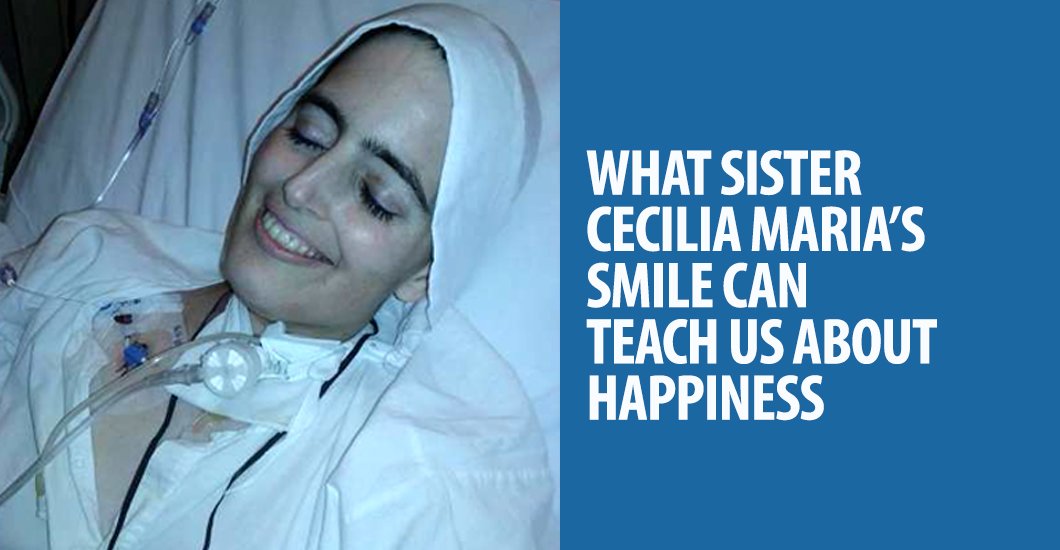
The last photo of Sister Cecilia Maria, the Argentinian Carmelite sister who recently died of cancer at age forty-three, has drawn the attention and affections of the Catholic world.
Accounts tell us that Sister often played the violin for her fellow Carmelites as a sweet gift of music, but it was in her final moment that Sister Cecilia Maria provided her smile as one last antiphon of sweetness to the world. And it is worth pondering her smile, and her life, because she had some very important lessons to teach the world.
First, she reminds us what beauty really is.
For a society that is so focused on beauty, very little attention is spent on defining beauty. What is beauty, and what relation does it have to love? What relation do love and beauty have to happiness?
These questions are not original to this author; indeed, these are the primal questions of the great literature, the great thoughts, and the great philosophy. But we have stopped asking them, not because we have answered them properly, but because we stopped caring about the questions.
Yet, regardless of philosophy, society nevertheless proffers its explanation of beauty. Sadly, these explanations are often tepid, if not altogether stupid.
Case in point. The covers of Vogue and Cosmopolitan magazines serve as a microcosm of a generation that has lost it; indeed, who is lost. The cover girls are gaunt, distant, and unhappy looking?all by editorial design. Their God-given inner beauty has been robbed; they often embody a plasticity of soullessness, and that denial of soul is a bigger lie than any airbrush could ever accomplish. These ubiquitous covers offer our wives and daughters a poorly-scripted fictional world that is governed by mannequins.
Then, in a stroke of spiritual serendipity, we see the picture of Sister Cecilia Maria; in a striking and immediate contrast to the faux world of models, we see the type of beauty that is borne of love and happiness. Among the vast array of cover girls who look dour in life, here is a woman who looks majestically happy in death.
Truly, hers is the countenance of Christianity. Christianity may not be in vogue, yet if one seeks the issue of happiness and fulfillment, the love of God is where to look.
Whereas our society is like a man who holds the key to happiness in his hand, yet insistently looks for it elsewhere, the smile of Sister Cecilia illustrates that she looked for happiness in all the right places. And found it. She showed the world the inescapable connection between love and beauty.
Second, Sister?s life and death also showed us the importance of truth, and its connection with beauty.
The worst lie ever told was that we can be happy apart from God. The original sin was the product of the original lie?a perfect untruth told by a master rhetorician. And one of those lies is that a life dedicated to God is an exercise in futility.
Ironically but predictably, much the world looks at Sister Cecilia Maria and thinks that she missed out. She missed out on almost all the things that are supposed to make women happy today. She missed out on the material of modernity. She missed out on the high-priced wardrobe, the high heels, and the high-power career, the travel, the treats, and the trinkets, the bling, the boyfriends, and the breakups. This discalced sister, spiritually tethered by her vows, whose wardrobe essentially consisted of one dress and zero shoes, missed out on everything.
Everything except happiness.
Everything except God.
In truth?because of truth?she missed out on nothing.
In truth, it is those who are insistent on sin who are missing out. As a wise priest once put it, ?Sin is boring; virtue is exciting.? The biography of sin has a million chapters, but all of them are the same boring story. Each with a storyline of sadness.
Twenty-three hundred years ago, Aristotle posited that the key to happiness is simple?aggravatingly simple. Aristotle wrote that ?happiness is an activity of soul in accordance with perfect virtue.? The ensuing twenty-three centuries have witnessed a world that has strenuously objected to that basic truth observed by the philosopher.
But Sister Cecilia Maria knew this central truth, and her life and death were in accordance with virtue.
One of the most exciting things about the smile of Sister Cecilia Maria is that she seemed to glimpse into a future that can be ours. For some people, that kind of thought might be intimidating. After all, the thinking might be that while Sister Cecilia Maria is exactly the kind of person who goes to Heaven, I am not.
But if that is your thinking, look a little closer at her smile. Hers is a smile of assurance and trust. It is a smile that acknowledges a merciful and loving Creator.
Whether you have lived a life like Sister Cecilia or a life like Saint Dismas, whether you have loved God since your infancy or began loving Him in your final moments, the same merciful and loving Creator awaits you.
There is a saying that Dismas ?stole Heaven? in his last moments. But this is untrue. Heaven is ours?ours to gain or ours to lose. The deed to Heaven was signed in blood by Our Savior?s deed on the Cross. Heaven is not stolen; you cannot steal that which God has purchased for you. It is not Heaven, but hell that is stolen.
The beautiful truth is that God made you to be happy with Him. Sister Cecilia Maria recognized this. In her final note, she wrote, ?I was thinking about how I would like my funeral to be. First, some intense prayer, and then a great celebration for everyone. Don?t forget to pray, but don?t forget to celebrate either!?
Sister Cecilia Maria?s death, her life, and her smile were a testimony to happiness. Our Lord assured us that the world would know we are Christians by our love. What Sister reminded us is that part of that love is a smile.

John Clark is a graduate of Christendom College, holding a degree in Political Science and Economics. He is a professional author and speechwriter. His book ?Who?s Got You? Observations of a Catholic Homeschooling Father? has reached #1 in the Amazon Kindle ?Fatherhood? category. He has written scores of articles about Catholic family life and has been published in such places as Catholic Digest, Latin Mass Magazine, Homiletic and Pastoral Review, and CatholicExchange.com. He publishes a popular monthly column in Seton Magazine and a weekly column for SetonMagazine.com. He and his wife Lisa have nine children. Reprinted with permission from Seton Magazine.
Related Articles
I'd never met him before... and yet he said I saved his life... It was the eve of the 4th of July. Bella, my fifteen-year old daughter and several of her friends were upstairs playing video games. They barreled down the stairs and came into the kitchen where my husband and I were chatting. ?Mom, we are all hungry. Can you make some grilled cheese sandwiches for us?? Bella asked. ?Sure,? I said. ?Randy wants to ask you a question,? Bella said. Randy walked toward the stove. ?You?ve been here once before, haven?t you?? I said to him as I grabbed a pan and turned on the stove. ?Yes, a month or so ago,? he replied with a huge warm smile. ?That?s right. Where are you from?? I asked. ?Well my family is from Morocco,? he said. The Trigger Randy had a sweet, kind presence. I wasn?t sure if he went to high school with Bella or if they had met through social media, football games or a party. ?Wow, how exotic,? I said with a big grin. ?So do you go to Bella?s school?? ?No,? he said. ?We met this summer on the beach.? ?Oh, okay, what?s your question Randy?? ?Did you talk my mom out of an abortion when she was pregnant with me?? I was taken completely off-guard. Who is he? Where does he live, I wondered as I stared at him, wracking my brain to recall if I?d had an interaction with his mother long ago. I was certain it couldn?t have been me until I looked at Bella and Randy standing side by side. Suddenly, I recalled an interaction with a young woman when I was pregnant with Bella. ?What is your mother?s name?? I asked. ?Maryam,? he said. Chills ran down my spine. How on earth did her son end up in my kitchen ?and friends with Bella? I looked him in the face. ?Yes, I did.? I said. Randy rushed over to me and wrapped his arms around me. He squeezed me tightly. ?You saved my life. You saved my life. Thank you. Thank you,? he kept saying. We stood in the kitchen locked in a hug for several minutes. Catch Up I turned to my husband, ?Can you believe this?? ?No, I can?t,? he said, staring in disbelief. Randy called his mom and filled her in on our conversation. He then handed me the phone. ?I asked God to help me find you again and He did! Can you believe Randy and Bella are friends,? Maryam said as her voice cracked with emotion. ?I can?t believe any of this Maryam. Truly, I?m overwhelmed,? I said. Before we hung up the phone, we made plans to get together to ?catch up? on the last fifteen years of our lives. My husband kept shaking his head. ?I remember when you came home that night. I told you were crazy because there was no way you would talk her out of an abortion,? he said. I thought back to that night almost sixteen years ago. It was a Saturday, and I was at dinner with my sisters and some friends. I sat at the head of the table because we were celebrating my fourth pregnancy. Our waitress was a beautiful, elegant dark haired young woman who was also pregnant. A Treasure Within After dinner, the waitress handed me my leftovers and then squatted down beside me and whispered, ?I wish I could celebrate my pregnancy too, but I can?t. I have an abortion scheduled this coming Wednesday morning.? I was shocked and saddened. ?Why are you having an abortion?? I asked. ?I am not married, and in my home country my parents will be exiled from their town and lose their business if anyone finds out their daughter is unmarried with a baby.? ?That?s terrible, but how will they know?? ?They will know. You don?t understand,? she said. ?You?re right, I can?t possibly understand, but what I do know is that God wants you to have this baby, or He wouldn?t have given it to you.? ?I am not Christian like you, I am Muslim. I don?t have the same God as you,? she said. ?Yes, you do. There is only one God,? I said. ?My boyfriend and I are struggling; things are very bad between us.? ?I?m sorry you are struggling. I have three other children. When my oldest was diagnosed with a rare and deadly disease early on, we could not imagine that he would still be with us today. And now at 42 I?m pregnant with my fourth child and facing my fourth cesarean section. But despite that, I can tell you that no matter what happens with your boyfriend, and despite your difficult situation, this child will be your treasure, you will see.? ?I have no-one, I can?t do this.? ?You have me. Give me your number and I will call you in the morning.? I looked at her nametag as she quickly jotted down her cell phone number on my to-go box and we said our goodbyes. I called Maryam the next morning. She explained her financial situation and shared some of the details of her relationship with her boyfriend. I understood why she thought her only way out was an abortion. I couldn?t imagine being in her predicament. I told her about a local pregnancy center and gave her their phone number. Against All Odds The day before her scheduled abortion, I called Maryam again. She shared the amazing news that the pregnancy center was going to help her and that she had cancelled her abortion. We continued to talk off and on throughout our pregnancies, but after our babies were born, we lost contact with each other. I looked at Randy. ?Your mom was a beautiful young woman who became pregnant and found herself in a hopeless mess. The night we met, she felt alone, lost, and full of shame. All I did was remind her that God doesn?t build houses of shame, people do. He builds houses of grace, and He wanted to give her an unrepeatable treasure in you. Your mom?s courage to have you against all odds was heroic. I?m grateful I was one of the small pieces God brought together through a chance encounter.? I turned to Bella. ?And you were an important part of it too, because Maryam would never have confided in me if I wasn?t pregnant too.? Bella?s beautiful almond-shaped eyes opened wide as she smiled with pride. Loving Maryam and listening to her that night required very little of me. After all, she wasn?t my unmarried, pregnant daughter. I wondered if I would have reacted the same if it had been my daughter? My interaction with Maryam challenges me to be a mom who responds to the mistakes and failings of my children with grace and belief in their goodness rather than shame and judgment. I want to be the person they come to when they are in trouble so I can remind them that they are not their mistakes. I want them to know that I have made many messes in my life through my mistakes, failings and sins, but through them I have experienced the redeeming and transforming love of God, and they can too.

Is church imposing ?burdensome moral restrictions? on people who have same-sex orientation? Get the facts straight, right here Over the years, I have had very fine students in my classroom who have a same-sex orientation, and, of course, as a Deacon of the Church, I know a number of practicing Catholics with a same-sex orientation. It is important to note right away that many people with same-sex orientation do not live a sexually active lifestyle. Many have been down that road and have found it wanting (i.e. not all that it was cracked up to be). Many are committed to the virtue of chastity?a part of the virtue of temperance. In other words, many same-sex Catholics have come to realize what many heterosexual couples have yet to realize, namely, that happiness does not come from an intimate sexual relationship. Rather, happiness comes from a profound relationship with God, and a moral life consistent with such a relationship. Unless a person has had a genuine encounter with the Lord, much of the Church's moral teachings will appear to be little more than burdensome impositions, that is, unnecessary restrictions on our own happiness. If Only? What is interesting is that a number of Catholics with same-sex orientation have explicitly pointed out that the unwillingness to be direct, that is, the unwillingness to come out and teach the basic principles of Catholic sexual teaching, has actually done a great disservice to them. Had clergy, catechists and teachers been more responsible and shown greater solicitude for the faithful in teaching about sexual ethics and the nature of marriage, they (clergy, catechists, and teachers) might have saved them (Catholics with same-sex orientation) from a great deal of pain and wasted years. In other words, the picture that is often painted by media and popular culture is that persons with same-sex orientation are all on one side, and the Church with its "burdensome moral restrictions" is on the other. Such a picture is just not true to the facts. There are many Catholics with same-sex orientation who are well aware of the difference between pleasure and joy, chastely living very devout lives centered around the Eucharist, taking their inspiration from those priests and Sisters who are faithfully living their vows of chastity or promises of celibacy. Sexual morality cannot be understood outside of an understanding of the nature of marriage. I teach Marriage Preparation for the Archdiocese, and I can say with relative certainty that the majority of couples getting married today are not entirely clear on what it is they are doing when they choose to marry. In other words, they are not entirely clear on what marriage really is and how it relates to sexual expression. This is understandable because we live in a culture that has really lost a sense of the true nature of marriage. There are number of factors that might explain this, beginning with the Sexual Revolution of the 60s; the introduction of no-fault divorce in the late ?60s; the introduction of Common Law "marriage" (a couple cohabitates for a period of time and is then treated by the state as if they were married); the separation of sex from the idea of children (a separation made possible by the production and distribution of modern contraceptives, etc.). But marriage has always been understood as an institution. It is more than a friendship?our friendships are private, they are not institutions. Marriage is an organization that exists for the public welfare (institution). Just as a cell is the basic unit of a living organism, marriage is the fundamental unit of society. Marriage is a unique phenomenon.? Ever After In short, it is a joining of two into one flesh, one body. It is a complete (total) and mutual giving of the self to another, and since "you are your body", to give yourself is to give your body. Because it is a complete and total self-giving, it is irrevocable?I cannot revoke what I give if I no longer hang on to a part of what I am giving. If it is mutual, the two have given themselves over to one another such that her body belongs to him and his body belongs to her. They have become a one flesh union. The natural expression of this union is the act of sexual intercourse (the marital act). In this act, male and female become "reproductively one organism" (a male is reproductively incomplete, and so too a female. But in the marital act, the two become reproductively one body). In the sexual act, the two become a one flesh union, which is what marriage is. And so, the sexual act is an expression and celebration of conjugal love (married love). There is a two-fold goodness to the sexual act; it serves two purposes: 1) to express and celebrate married love, and 2) the procreation of new life. That is why one of the impediments that renders a marriage invalid (non-existing) is impotence, which implies the inability to actually perform the sexual act (the inability to consummate the marriage). Infertility is not an impediment to marriage; it is not necessary to actually have children in order to be validly married, but the openness to children is a necessary condition for a valid marriage, and so the deliberate intention not to have children renders a marriage invalid (non-existing). Other impediments that render a marriage invalid are coercion, fraud (he's not the person you were led to believe he was), leaving an opening for divorce (the intention must be until "death do us part"), psychological immaturity (the moral and psychological conditions to actually be married are just not there in at least one of them?this is a serious problem among many people today, for the culture in which we live is not conducive to producing morally mature adults). Marriage as understood by the Judeo-Christian tradition is an objective institution with a determinate nature. It is not a social construct, as the postmodernist claims it is. And because marriage is a joining of two into one body, one flesh, it can only be achieved between a man and a woman. It is not possible for two people of the same sex to actually become one body in the act of sexual union; in other words, it is not possible to consummate a marriage if the two are of the same sex. Sexual ethics?for us, at least?always starts from an understanding of the marital context. Pre-marital sex is fundamentally an instance of lying with one's body?for the two are expressing and celebrating a marriage that isn't there. But the sexual act between a genuinely married couple is a holy act; it is a grace-meriting act. Outside of that context, the sexual act is usually and for the most part a matter of procuring sexual pleasure. To have sex with another person not as an expression of a complete and total giving of the self in marriage, but merely as a means to sexual pleasure, is to use other as a means to an end; and using another as a means to an end is always a violation of a basic moral precept to treat others as ends in themselves, never as a means to an end. Finding Happiness There is far more to this philosophical/theological understanding of marriage and the meaning of the sexual act than can be adequately expressed in an article of this size, but for a large percentage of the population, sex is no longer really anything that has a great deal of significance. It is often not much more meaningful than having a martini or heading out to the Dairy Queen for a sundae, something you can do with almost anyone. But the Church's determination to protect the nature and sacredness of the sexual act and the true significance of marriage is rooted in her conviction that marriage/family is the fundamental unit of society, and anything that harms that unit harms the civil community as a whole. And so, the Church calls those persons with a same-sex orientation to a life of chastity. Now this may sound cruel to some, but it might very well be the case that it is the opposite approach that is actually cruel. Moreover, clerical celibacy is probably more important today than it ever was. A good-looking priest or Sister who has taken a vow of chastity or promise of celibacy, and radiates joy, gives very powerful testimony that happiness (or joy) does not come from an intimate sexual relationship; but rather, happiness is found in Christ. It's even difficult to get married couples to see this. They often believe that their happiness will be found in one another. But Saint Augustine said it long ago, on the first page of his Confessions: "Oh Lord, You created us for Yourself, and our hearts are restless until they rest in You". In other words, God created you for Himself, not for another. Complete happiness cannot ever be found in another human being, but only in God. If God calls a man to married life, He is calling him to love his wife for her sake, not for his own sake or his own happiness. He is calling this man to love God by loving this woman for her sake and for God's sake. Unfortunately, many people "reveal their hand" by the words they speak, saying such things as "he fills a void within me", or "I just didn't feel fulfilled anymore, so I left her", as if marriage is about "my fulfillment". Beyond Measure There is a tremendously rich heritage in this area of sexual ethics and the nature of marriage in the history of the Church, which has undergone tremendous development in the 20th century (i.e., the Theology of the Body), and when we teach this to our students, they really do react positively. And this is true also of those students who have same-sex attraction. Many of them discern the truth in these teachings and are grateful to receive them. Unfortunately, many clergy are afraid to teach it, and many educators are just not familiar with it. The fact of the matter is, we all have our own struggles. Whatever road the Lord calls us to walk, there will be sacrifices we will have to make, battles against ourselves and our own unique proclivities that we will have to engage in, but our eternal happiness is precisely at the end of that road. More importantly, "the road to heaven is heavenly"; conversely, "the road to hell is hellish". When people come to chart out their own unique battlefield and specific road that the Lord is calling them to follow, with all the sacrifices they will be required to make, they begin to experience a joy that they didn't think was possible. Most people are under the illusion that I will only be happy when I get to do what I want to do; they often go down that road and discover that they are not happy at all, much to their dismay. But when they finally begin to do what the Lord is calling them to do, they discover something that they had no idea they would find, namely, a deep sense of fulfillment.

Wondering how to respond to those comments about your witness to life? Here are 3 best comebacks just for you! Just last week, I parked our large van out the front of the local shop. After quickly grabbing a few grocery items, I returned to find my children conversing with the occupants of the vehicle parked next to us?a father and his young son. In a small town such as ours, there are always tenuous links to other people. In this case, the young boy in the utility had attended preschool with our fourth child and wanted to say hello. The door to our van was opened to accommodate such a greeting. I could see the father?s mind boggling as he took in the number of children in my vehicle?six?and then noticed the now unmistakable bump announcing the expectation of number seven. His comment was one of those common ones large families encounter with annoying regularity: ?You should get a TV.? He added an, ?or something?, to his comment and an awkward laugh that only proved that he had recognised the rudeness of his comment. But it was too late to take it back. Smiling a very forced smile, we made our goodbyes and headed home. This was not the first time I had encountered such comments, and it would not be the last. The truth of the matter is that the size of my family is somehow confronting to a large proportion of society. ?They just can?t understand,? says a friend, and mum of six, ?what joy we experience in being blessed with a large family.? She is right. Being blessed with a large family is something very different to adhering to the 2.1 children per family and, from the outside, appears very counter cultural. Of course, it is counter cultural, but it should not be. Not all of us are called to have a ?large? family but we are called to be open to life. For some, this does mean a large family, but for others it means a small family, dealing with and encountering pregnancy and infant loss, struggles with fertility, fostering, or adoption. Regardless of the size or make-up of our family, we can all witness to the profound blessing of being open to life. 1. Radiate Joy The news of a new pregnancy should be a time of great joy. There are some times and some situations, when this news might be more subdued. Regardless, a new life should always be celebrated. When you encounter others, whether they share your open-tolife outlook or not, let them see the joy that this announcement carries with it for you. Joy is infectious?and something often sadly lacking in our world today. Maybe they still cannot understand why you would want to have your fourth, sixth, seventh or eleventh child, but they should still be able to leave their encounter with you knowing that you are delighted to be expecting another bundle of joy. 2. Respond with humor, not anger There are any number of rejoinders one could give to those clich?d phrases: ?Don?t you have a TV?? or, ?Don?t you have your hands full?? and so on. But some are probably not charitable. We are not going to change hearts with our angry response. Or, let us be honest, with whatever response we give. But, perhaps we can sow a seed. A mother within my acquaintance likes to tell the following story of one mother?s response to the following questions: ?Why do you have so many children? Or, you?re having another one?? The cheeky response: ?We?ll keep going until we get one we like!? Or, alternatively: ?We?re just making sure we have plenty of children to look after us in our old age.? Maybe these quips are not for everyone. But humor can be a great tool in responding to the more puzzled queries of the more secular among us. Saint John Cantius encourages us to: ?Fight all error, but do it with good humour, patience, kindness, and love. Harshness will damage your own soul and spoil the best cause.? Maybe adding a dose of humor will be just the thing. 3. Witness without words Although I have been on the receiving end of less than ideal comments about our family size, I have also been on the receiving end of the most beautiful ones too. One older lady in particular began with the clich?d: ?Haven?t you got your hands full?? and added, ?and aren?t you blessed?? Of course she is right. We are incredibly blessed and those who know us, know that our openness to life extends much further than our own home. We have had people come to us for help, guidance and support in the face of unplanned pregnancies, difficult post-birth periods, undertaking fostering or adoption, and the general ups and downs of parenting. Often acquaintances who are not Catholic seek our counsel. By the virtue of our family size, we somehow broadcast our sincere belief that all lives are precious. This has been an unintended consequence of having a large brood. In and of itself, it has been an immense blessing for us to support others. Without deliberately intending to, we are following the advice of Saint Francis of Assisi: ?Preach the Gospel at all times. When necessary, use words.? So, although you can expect impertinent comments, that does not mean that you should tone down your own enthusiasm when sharing the news of a pregnancy?whether it?s yours or anyone else?s. Respond with joy and humor, continuing to witness to the preciousness and dignity of all human life.

?I, Joey, take you Brigid, as my wife. I promise to be true to you in good times and in bad, in sickness and in health. I will love and honor you until one of us becomes unhappy.? Wait. What?! As funny as it sounds, the sad truth is that some people leave their spouse because they become unhappy. Undoubtedly, there are numerous causes of divorce. I would like to focus on one problem I believe is underneath many marriages that split: consciously or not, we expect our spouse and marriage to make us perfectly happy. In ?Three to Get Married,? Venerable Fulton J Sheen wrote: ?In all human love it must be realized that every man promises a woman, and every woman promises a man, that which only God alone can give, namely, perfect happiness. One of the reasons why so many marriages are shipwrecked is because as the young couple leaves the altar, they fail to realize that human feelings wain and the enthusiasm of the honeymoon is not the same as the more solid happiness of enduring human love ? In the first moments of human love, one does not see the little hidden deformities which later on appear.? In his fatherly way, Saint John Paul II often tried to shatter the illusion in young people that marriage will only bring endless romance and happiness. He knew if we make an idol out of anything, it will eventually leave us empty. Only God can satisfy the ache in our hearts for perfect love and happiness. Yet we often look to another person for the love that only God can give us. IF NOT HAPPINESS, WHAT ?S THE PURPOSE OF MARRIAGE? ?Marriage does not exist to make you happy; marriage exists to make you holy,? said Jason Evert. In other words, marriage exists to make you a saint; to transform you into the best version of yourself and draw you closer to God. Of course, marriage also exists for the procreation and education of children. Simply put, it means being open to life, parenting well, and helping your children become saints. (See ?Catechism of the Catholic Church,? 1601). God is love. The central mission of our lives is to perfectly reflect His image. Therefore, the more authentically we love, the more we become like God and, consequently, the more we become ourselves. However, to love like God does, it is necessary to deny ourselves and choose what is best for those we love. That will inevitably lead to suffering. Jesus on the cross is the perfect example. Saint Clare of Assisi knew this when she said, ?Love that cannot suffer is not worthy of that name.? When the struggles come, do not become discouraged. Rely on God?s grace via the Sacraments. Ask Our Lady for assistance. Find a good spiritual director to guide you. Remember: You were made for greatness. Did you think it would come easy? Nothing worth having comes easy. No Olympic athlete ever won gold by watching Netflix or quitting when sacrifice was required. He or she endured gruelling training just to win a piece of metal. Why should you expect any less sacrifice if you want a great marriage? Does that mean marriage will be miserable? No! Marriage will be wonderful and difficult, joyful and frustrating, beautiful and challenging, just like life. The real measure of a successful marriage is not how happy the couple feels but rather how virtuous and holy each spouse becomes. As you discern and head toward marriage, here are five ideas to purify your idea of marriage. 1. Make God the center of your life and ask Him to purify your idea of marriage. 2. Remember: Marriage does not exist to make you happy; it exists to make you a saint and holiness is the path to authentic joy. 3. Set realistic expectations for marriage by spending time with good families and holy couples. 4. Unhappiness in your marriage is not a sign that you chose the wrong vocation, married the wrong person, or that you should leave your spouse. 5. Do not despair. Even amid struggles, a great marriage is possible with God?s grace and your hard work.

Satan is the father of lies, clever yet deceitful, hating God and all God loves. He leads the charge in the spiritual battle that exists for our souls, opposing God at every turn and trying to turn us against Him. yet, God has given us a glimpse of Satan?s playbook in the first three chapters of Genesis so we can better know our enemy and recognize some of the ways he has continued attacking humanity since the beginning. The Sacredness of Creation and dignity of man In the beginning, God created all things good. God blessed the living creatures (Genesis 1:22) as well as man (1:28), revealing the sacredness of all life. To man, God gave dominion over the living things (1:26f), demonstrating the hierarchy of life. man was also a unique creation in the material world as he was made in the image and likeness of God (1:26), being given the gifts of reason and free will. God breathed His own life into man (2:7), further elevating the dignity of the human person and bestowing into man His own divine life. Man and Woman?For marriage and Family In the creation narrative, the only time God says something ?is not good? was when man was alone. God revealed man was created to be a social creature but the relationship with animals was not adequate. The relief for man?s solitude was another human and particularly a woman (Genesis 2:18f). To be in a relationship with this woman, man had to be willing to give up everything for her, even giving his own life in loving protection. With His consent, God formed woman from the side of man?not from his head to be superior to him, nor from his feet to be subjugated to him (2:21-24). They then formed an indissoluble covenant with each other (becoming one flesh). This relationship was not one of pride, selfishness, egotism, possession or subjection. It was to revolve around love, not lust (2:25). Made for Communion with God In the Garden, God walked with Adam and Eve (3:8), revealing a harmonious friendship. This relationship with God was what man was ultimately made for, but God wanted this communion to continue for all eternity. For man to fulfill his purpose, he only needed to respond to God?s love with love. Wanting to illuminate the path for man to achieve this, God gave man a few laws, not acting as a dictator but as a loving Father (2:18). These commands were: ? Be fruitful and multiply. Fill the earth, subdue it and have dominion over it (1:28). ? Man was to guard and labor in the Garden of Eden (2:15). ? They were given access to everything in the Garden of eden with one exception; they were not to eat of the tree of knowledge of good and evil or else they would die (2:16-17; 3:2-3). Losing Trust and the Slippery Slope of Sin Genesis then shows how Satan cleverly and deceptively entered into the life of this first man and woman (3:1), hoping to lead them to doubt God and His loving plan (3:5). In their interaction, the devil immediately distorts God?s truths (3:1), implying God is a liar (3:4-5). Satan insinuated God was restricting their access to goodness, pleasure, power, wisdom and the fullness of life (3:4-6). Satan distorts the nature of God and the truth of who God created man to be. Satan wants them to revolt so he tries to convince Adam and eve that God is a despot. Satan prods the pride, selfishness, greed and envy within man, telling them there is something they deserve to have (to be like God) that God is withholding from them (3:5). Satan also demonstrates that part of his plan of attack is to destroy their relationship with each other. First, he humiliates Adam by the sheer fact of his presence in the garden because this indicates a failure in Adam to lay down his life in loving protection of eve. Then, even though both Adam and eve are present in the garden, the serpent isolates them by speaking only to eve (3:1). Satan also tries to manipulate Adam and eve by convincing them there are no negative consequences to their actions. The sly serpent tells them, despite God?s warning, if they eat of the forbidden tree, ?you will not die.? No, rather ?your eyes will be opened, and you will be like God, knowing good and evil? (3:4). Satan, having rejected God, personally knows with certitude what happens when you turn away from God, yet this truth must remain hidden in order achieve his goal. Instead, he veils his lies with the appearance of compassion and concern giving the illusions: God lies. There is no truth. Satan, not God, has the means to our happiness. Adam and Eve freely succumb to the temptations of the devil. But the impact of Satan?s war does not stop with this act. Immediately after they sin, their guilt causes them to hide from God or, as in the Hebrew chaba, to withdraw from God (3:10). Rather than repent, they refuse to accept responsibility for their disobedience, merely blaming one another (3:12-13). Finally, prior to the fall, Adam and eve did not bear children as God had commanded so this encounter with Satan impacts all their descendants?though not inheriting the guilt of the first sin, all humanity will experience the consequences. Deceptive Snares Then and Now Our first parents fell into Satan?s traps but we continue to hear echoes of these same deceptions in our lives today. Just as Satan distorted truth about God from the beginning, lies and deception continue: ? ?There is no God. We are here by chance.? ? ?Religion consoles and comforts people but it is not based on truth.? ? ?Even if there is a God, He cannot be good and loving since there is so much suffering and evil.? ? ?I believe in God but He has done nothing for me so why should I listen to Him?? Just as in the Garden Satan attacked who it was God created man to be and the dignity of human life, this is still under attack everywhere: ? ?Humanity is depraved, wretched, unredeemable.? ? ?Dog, cow, man, we are all the same. A creature?s level of consciousness or his usefulness to society determines its value; therefore, pigs and chickens are more valuable than a human fetus or newborn.? ? ?Pregnancy is an inconvenience, a burden, a mistake.? ? The fetus is simply a clump of cells.? ? ?A woman has a right to do what she wants with her body since the child in the womb has no rights of its own.? ? ?A person should have the right to end his or her life if he or she feels his or her situation is too burdensome.? ? ?Once a person is merely a burden on society, we have the right to end that person?s life.? As with Adam and eve, the reality that it is God who is the source of our goodness and happiness has been rejected in favor of a counterfeit idea that we are to take what we desire and find happiness apart from God: ? ?Seize the day. Do what makes you happy.? ? ?What is true for me may not be true for you but let?s live and let live.? ? ?If you hold to universal moral truths, declaring what is right and wrong for all, you are an intolerant bigot.? ? ?Don?t impose your views on me.? ? ?God?s moral laws are examples of imposed tyranny, you do not need to succumb to this.? ? ?You do not need God or any church to do be happy.? We hear a constant attack on marriage with propaganda denying the complementarity of the sexes: ? ?If you marry, divorce is always an option if it does not work out.? ? ?Why get married at all when I can enjoy the benefits without the commitment?? ? ?It is about me and my body. Why not explore the different options? There should be no limits on satisfying my needs.? ? ?There is no such thing as complementarity of the sexes?it is just whatever feels right in my marital relationships.? ? ?There is no such thing as being born male and female, you get to decide for yourself.? Since the beginning, Satan has been promoting a denial of the reality of sin. As we see in the Garden, this often leads to a refusal to repent: ? ?Sin is when I go against my own personal values. You cannot decide for me what is and is not sin.? ? ?You are an intolerant bigot for even suggesting what I did was wrong since it is only wrong in your eyes.? ? ?A loving God would want me to be happy. He would not condemn me for living however I see fit to achieve this.? ? ?God is a loving Father. I cannot imagine He created a place like hell but, if He did, my merciful Father would not send me there.? ? ?That wasn?t my fault.? Knowing our Enemy We see the fingerprint of Satan throughout history and all around us today. He is powerful and cunning, always trying to convince us to doubt and lose trust in God like with our first parents. Father Vincent miceli, in his book ?The Antichrist,? writes, ?The intention of Satan is to make a physical and spiritual wreckage of all God?s creation.? We must be aware that Satan always mocks God, breathes contempt on anything sacred and ridicules all God has revealed. The father of lies wants us to believe he will lead us to true happiness more than any teachings of Christ. Father Miceli describes how Satan, with the help of men and his demons, has ?succeeded in contradicting scripture, denying dogma, popularizing immorality.? He will try to deceive us in subtle ways, hoping to lead us further and further away from God, so we can never become presumptuous or let down our guard. Wanting to help us take care to not fall into Satan?s snares, God has given us many warnings and insights into Satan?s playbook, with one example being in these first three chapters of Genesis. As we become more aware of our enemy, we then must heed the words of Saint Pope Leo the Great, in his Sermon 39 on Lent (III): ? let us prepare our souls for fighting with temptations and understand that the more zealous we are for our salvation, the more determined must be the assaults of our opponents. But ?stronger is He that is in us than he that is against us? (1 John 4:4), and through Him are we powerful in whose strength we rely: because it was for this that the Lord allowed Himself to be tempted by the tempter, that we might be taught by His example as well as fortified by His aid ? He fought then, therefore, that we too might fight thereafter: He conquered that we too might likewise conquer. For there are no works of power, dearly-beloved, without the trials of temptations, there is no faith without proof, no contest without a foe, no victory without conflict. This life of ours is in the midst of snares, in the midst of battles; if we do not wish to be deceived, we must watch: if we want to overcome, we must fight.

Sometimes the best thing you can do for the pro-life cause is to just "smile and walk out into the world." I have been to marches; I have prayed at clinics. I have written articles and letters to the editor. I have ten children. Yet, the most effective witness I ever gave to the pro-life cause was when I was not trying to do anything other than find a way to not be lonely. Back in 1993, I became a mother and I felt the walls of the world encompassing me. So I went out seeking connections and adult conversations and anything to help distinguish one day from the next as I worked to recover from pregnancy and adjusted to being a full-time mom. One day, I saw the receptionist at our apartment management company and it looked like she had been crying. When I asked her what was wrong, she told me, ?You.? I did not understand, but she invited me in to sit with her. It turned out she had just broken up with her boyfriend and found out afterward that she was pregnant. Two girlfriends already offered to drive her to get an abortion, but she said seeing my son every day, holding him as he smiled and kicked, she could not. She just could not. Her reaction to me actually echoed my own reaction to someone else: I had become a stay-at-home mom because I had seen a baby boy in the daycare and witnessed his smiles. I could not not be with my son, I just could not. That unknown baby?s smiles led to my staying home and being desperately lonely ? and that led to sharing my son?s smiles with this pregnant receptionist. I hugged her and we cried over her worries. We talked about what she could do. I had never counseled anyone before, but we created a plan. It involved calling a doctor to get checked, calling her folks to get support and calling her boyfriend to let him know. I did not know what would happen but told her we would be there for her regardless. She gave my son a kiss and dried her eyes. I left thinking that the loneliness of being a new stay-at-home mother was nothing compared to hers. It rained hard for the next week, so I did not get out for my daily walk. The few times I made it by the office, she was not there. I worried. However, the next time I saw her she threw open the door and hugged me. Everyone had rallied for her?her boyfriend and her parents. Now instead of the loneliness, there was a family fully engaged and fired-up alive, eagerly anticipating the child?s birth. They married and before I moved away, they had had a son and a daughter. My son?s smiles allowed another two children?s smiles to be known to the world and a whole host of smiles for the mom, the dad and the grandparents. It was not marching or protesting or lobbying that won a heart in a crisis pregnancy. It was presence. While we march for all those who were not given the opportunity of life or who were wounded by abortion (fathers, mothers, siblings and everyone else) and while we hope for a defunding of Planned Parenthood, we should recognize the other part of being pro-life: We have to be more pro-life and pro-living than protesting. Smile and walk out into the world and know that God will put you where you can be most effective.

Your wife will be like a fruitful vine within your home, your children like young olive plants around your table (Psalm 128:3). Ben and I chose this as the Responsorial Psalm for our Nuptial Mass nearly ten years ago. We imagined a fruitful life in every way, especially when it came to our dream of having a large family. Neither of us grew up in a particularly large family. I only have one younger sibling, a brother, and Ben has two younger siblings. Both of our mothers are only children. As we planned our wedding day, we discussed how lots of babies would fulfill our hopes of growing our home and expanding the family tree. Ben said, ?At least four kids? when asked by Father Joe during our FOCUS questionnaire. I was resigned to the number God had planned for us, certain that it could not be fewer than what Ben envisioned. But, as every faithful Catholic knows, God?s plans are often not what we expect. Yes, they are always greater than our hopes and dreams, but they are difficult to comprehend, let alone believe, when we are in the midst of such silent pain as infertility. When people see photos of our family, they do not realize that the two beautiful girls God has given us were not easily brought into being. After many bouts of appointments with our Creighton Fertility Care Practitioner and NaPRO doctor, I had to undergo several exams?pelvic ultrasounds, blood tests, new medications, more tests, wait several months, more tests and more self-administered shots. The roller coaster of infertility was excruciating. All people see are our smiles. They do not realize the many months I spent alone, sobbing, not knowing why it was so difficult for us to have children. The longing for more only lingers in my heart as we wait?again?to see what God has planned for us. It is a struggle to share one?s journey of infertility, especially when one already has children, because the world does not understand that pain. The message we hear is, ?You already have two children. Isn?t that enough?? Infertility is a type of grief over the child who never was. Ben and I mourned, at different times, over a phantom child?a yearning, a vision?rather than losing a child to miscarriage, stillbirth or other reasons (all of which are equally painful to infertility). When a couple chooses to follow God?s plan for building a family, it is always a way of abdicating self-will in favor of God?s will. This means always remaining open to children, saying yes when God may say no or not yet. Ben and I have come to see why the Church has such a beautiful vision of fertility and reproduction, because we live it every day. We have never used any kind of contraception and we have never pursued artificial means of achieving a pregnancy. Because we have allowed God to lead?even and especially when we were ready for another baby and had to wait indefinitely?we grew to profoundly respect God?s designs in creating another human life. With both of my pregnancies, I was keenly aware of God?s grand and special purpose for our girls. Though I carried them in my womb, I always knew first and foremost they were God?s children. Because I do not conceive children easily or immediately, I also grew in humility to defer to God?s perfect timing rather than my own. We must realize that, despite the fact that the world either views children as a burden or a commodity, they are neither. They are gifts. Children are not a right of every couple, which is a hard fact to accept. This means that we cannot force conception in ways that separate the unitive and procreative act of conjugal love between husband and wife. Many infertile couples will never speak of their grief because it is so private and tough to articulate. We do not offer this as a point of conversation because we know it is awkward and maybe too revealing. Yet infertility is a persistent, prevailing type of chronic grief that is always lingering somewhere in one?s mind and heart. The ache for a child?or more children?that is never fulfilled may be met with cries and pleas of desperation to God. We tend to ask ?why? rather than merely surrender our fertility to God, always with a willing and open heart, always saying, ?Yes, Lord. I give you everything. I trust you.? Even if we never have biological children, God may be calling some of us to foster care or adoption. If neither of these happen, perhaps God is calling us to be fruitful in other ways?as spiritual mothers and fathers. Those who struggle with infertility may experience it once, twice, three times or more. Some may have one child or more children or perhaps none at all, but the constant, nagging cross of infertility is knowing that one is barren in some way. When we can all accept that we are barren (figuratively or literally) and that this type of poverty is, in fact, a blessing, perhaps we will begin to view infertility differently. It will not alleviate the pain or compensate for the lack of pattering feet in our homes, but it will give us new hope and a different perspective. I consider all of the natural talents and spiritual charisms God has given me?writing, speaking, teaching, encouraging, nurturing and listening?and I realize that these are ways He has called me to be fruitful in the excruciating times of waiting and wondering if another baby will one day grace our home and family. We are all called to be fruitful vines. It is impossible to foresee the reasons why God may not bless our lives with children, but we can look to the ways He asks us to give of ourselves and our bodies in a mystical sense that will bear spiritual fruit in the hearts of those we encounter. Continue to say yes to God, and He will bring about immense good from that gift of trust.

Tell us a little about yourself and your family. I was born and raised in Pittsburgh, Pennsylvania. I am the middle of seven children. I was raised by my parents in the church and lived a simple life ? our big vacation was going to visit Grandma and Grandpa in Milwaukee. That seemed exotic and far way! By God?s providence, I met Luisa, my wife-to-be (from a family of Ten), while studying at the University of Pittsburgh. She was majoring in electrical engineering and was a year or two short of graduating when we got married. She made the courageous decision to leave her engineering studies behind and get a doctorate in being a full-time mom. We have been happily married for thirty-one years and have seven children ranging from 12 to 27 years old (three daughters and four sons). We have been truly blessed with the opportunity to allow Luisa to stay at home and raise our children. I witness the fruits of her labors every day in the growth of our children. What do you do professionally and how do you combine that with being a dad? For the last sixteen years, I have been a sales engineer for a company that designs and manufactures test and simulation equipment for the aerospace and other industries. This job has required me to travel a lot and I am often away from my family. This has been hard. However, I feel confident that God's vocation for me is to be provider and protector of my family. Bottom line: my marriage and experience as a father has strengthened me and made me better at what I do in my job. I know too many people who define themselves by their ?career." I used to also. Now, I am defined by my true vocation as husband and father ? and I have a job as well. Pope Francis is asking us to pray a lot for the family right now. What do you think is the biggest challenge facing the family today? We are in the world, but are called not to be of the world. We do not always like to think of how satan is active in the world and revels in our sins and failures. There is no greater satisfaction he can gain than by pulling holy men and women, young and old, away from our Lord. You can see him on TV, at the movies, on the streets, in the gossip at work and even in children's books. We need to be vigilant! The Holy Father is right! We need to pray for good, holy families to be protected, to grow in faith, hope and charity, to continue to be the foundational building block of society and to demonstrate to the world the joys of family blessings. A family with seven children is well above the national average these days. Is it hard to be a father to seven children? Are your children happy? I have heard it takes 2.3 children per family to just maintain a population. In the western world, most countries do not meet that criteria and so from a practical stand point, it is necessary to have children. More importantly, living your marriage in cooperation with Natural Law rather than against it brings many blessings, including children. And what a blessing they are! Yes, there are challenges. It is hard work, it can be tiring and it costs money to feed, clothe, house and school them. But with God, all things are possible. With commitment to my marriage, the love of wife and mother and having the good Lord in my corner ? seven does not seem so big. I think my children all realize the advantages of coming from a large family and how they benefit and enjoy their siblings (well, most of the time). Even though they outnumber Mom and Dad, they never wanted for attention, support or help. We were and are always grateful for the opportunity to nurture and love our children (even as adults). With a large family, we will never be deserted. We will never suffer alone. We will never be without support of one kind or another ? and we will never forget how much God truly loves us as we see His love revealed in the love found in our family. How do you see your role as father to your children? Over the years, there were times I felt more like a chauffeur for my children than a father. I would come home from being out of town and spend my evenings and weekends driving my kids to and fro. But in hindsight, I can see that our little car chats driving to and from soccer, lacrosse, field hockey, basketball, play practices, etc. were all opportunities to teach, love, understand and help my children. I pray most of all that I set an example to my children of how we all should live out the Gospel, to support and love the Catholic Church and live in obedience to God's plan for us. Being imperfect, I do rely on the grace of the Holy Spirit and the loving support and patience of my wife to help me strive to be a better father and husband. Your two eldest daughters are now no longer at home: Erin recently got married while Kathryn has discovered a calling in the spirit of Opus Dei, which seeks to spread the sanctification of work, and is living abroad. How have these changes affected your family? Kathryn's calling to Opus Dei is nothing short of a great blessing to her and our family. I have always known her to be a bright, creative and loving person. But her life as a numerary is manifested in the complete joy and abandonment to her calling. As I like to say, ?When I grow up, I want to be just like my daughter!" We can see the love she has for God through the work every time we talk, read her letters, Skype or on the great occasions of visiting her. As parents, to see your children grow up to be so happy, fulfilled, joyful and so committed to their faith ? well, is that not the outcome for which we hope, work and pray? My second daughter, Erin, was married to a fine young man last May. I could not be happier for them. The actual wedding was really something. It was a milestone, not only for our immediate family but for both of our extended families, as this was the first marriage in this generation. It was a big family event. My biggest worry was not about how much it would cost, or where the reception would be or other logistics. It was the worry of whether I would cry like a baby as I escorted my daughter down the aisle. I managed to keep my composure for that. A simple message: The wedding is but a day, the marriage is for a life time. Luisa and I are blessed to have them live down the street from us and so in a very day-to-day way we continue to see our daughter and new son-in-law grow in their new family life. We pray for them and trust their lives together will be filled with as many blessings as Luisa and I have had as husband and wife and parents. After almost 30 years of experience, what kind of advice can you offer to young parents? After 30 years of a blessed marriage, I am still making mistakes and learning from them. But in the big picture, I offer these points of advice: 1) Keep God as the center of your life?in your marriage, your family and your daily work. 2) He gave you a church: use it, participate in it, benefit from it. 3) Embrace the sacraments. All the graces that flow from them fortify you. 4) Pray together as a family. Even a small blessing heading out the door on a busy day is a good and wholesome thing. 5) Live out your wedding vows every day?to love and cherish each other. It is not always easy and fun. There will be times when you are hurt by or hurt the one you love. When that happens ? see 1, 2, 3 and 4 above. 6) Learn your faith, read about the lives of the saints and teach it to your children at home and at Catholic school if possible. They ask: How do we feed a million starving children? One child at a time. How do we convert the world? One family at a time, starting at home. 7) All the troubles, trials and tribulations that this world will throw at you are manageable with His action in your life. 8) Finally, on a practical note, more than not living above your means, live BELOW them. You would be surprised how much you can do without and how blessed you will be not only from having a little more in the bank but also from having the ability to be more charitable. What is your favorite part about being a dad? I am not sure I can say there is a favorite part of being a father. I have piled up so many experiences and memories as my kids grow: holding your newborn, falling asleep while reading bedtime stories, all the birthday parties Mom magically pulled together, the Baptisms, simple family hikes in the woods, enjoying eating dinner together as a family, laughing hysterically while playing board games, the first Holy Communions, the first day of school, sled riding, teaching them how to drive, coaching their teams and even the trips to the emergency room. While each child is a unique blessing, sometimes it seems like I have one big baby memory where all the memories of the different children merge together into one jubilant family remembrance. I guess it is the totality of fatherhood that is the best part. It helps me be a better servant, a better husband, a better Christian, and a better person.

Travel to any community in the country and you will likely find motels, hotels and restaurants that are happy to provide you ? for a price ? a room for the night or a hot meal. So extensive is the modern hospitality industry that some schools even offer degrees in managing these services. It is all a very convenient and useful social good. Traditionally, however, the concept of hospitality has had a rather different meaning, one that did not involve the payment of money in return. This older concept of hospitality, observed in many cultures, more resembled the gratuitous reception that is given now to family, friends, neighbors, co-workers and other guests. On this smaller, more personal level, it is an almost ingrained ethic today to ask a visitor ? whether in the home or the office ? ?Welcome. Would you like something to drink? Something to eat?? A good host wants his or her guest to be comfortable. We open our homes also for holidays, parties, graduations, funerals, and we host wedding receptions, offering food, drink, sometimes entertainment or a place to stay, and just as important, camaraderie. Mothers and grandmothers are especially renowned for their hospitality, not only to their own family members, but to others as well. How many of us remember going to a friend?s house when we were growing up and being asked if we were staying for dinner? This hospitality extends outside the home as well, expressed in etiquette and social conventions of holding the door for others, giving up your seat to a pregnant woman or older person, offering a portion of your lunch to someone who has none. Our parishes too should be places of warm welcome and sustenance. In these small ways, these small mercies, we help make the world a little bit better. This attitude of hospitality and warm welcome, sometimes expressed as, ?Mi casa es su casa ? My house is your house,? was in older times even freely extended to complete strangers and travelers, rich and poor alike, including foreigners. Before the age of interstate highways and pervasive hotels and restaurants, it was understood to be a vital social virtue, religious ethic and moral duty for both the elite and common people to open their doors and show generosity and courtesy to those away from home and widows and orphans too. Of course, the clergy and monasteries of the Church opened their spiritual homes as well to provide hospitality to people in need. The roots of this hospitality go back to the ancient world. Particularly in places like the desert regions of the Middle East, access to water, food and shelter was a matter of life and death for a traveler. God in his mercy had provided these necessities to his chosen people and so he instructs them, ?You shall treat the stranger who sojourns with you as the native among you, and you shall love him as yourself, for you were strangers in the land of Egypt? (Leviticus 19:34). The Lord commands this kindness be show to even foreigner travelers despite foreign domination being a constant prime concern of Israel. Holy Scripture provides an example of the hospitality we should practice when the Lord appeared to Abraham in the form of three men. Abraham waited on this manifestation of the Trinity, providing food, shelter from the hot sun, and water for the three visitors to wash their feet. The Lord then blesses Abraham and his wife Sarah with a son in their old age (Genesis 18:1-16). In the First Book of Kings, we read how the widow Zarephath received the prophet Elijah and, even though she was in dire straits with her food nearly gone, she gave him a portion. Again God gives his blessing ? Zarephath is given enough food to survive and when her son dies, the Lord restores him to life (1 Kings 17:8-24). ?Do not neglect hospitality, for through it some have unknowingly entertained angels,? we are told (Hebrews 13:2). Having been received in mercy by the Lord, hospitality is among the essential qualities that he expects of his good and faithful people, including concern not only for family and friends, but for those we do not know, for domestic travelers, foreign immigrants and refugees, and for all who are downtrodden, vulnerable and marginalized. Whether it is in the home, at work, in the Church, or in our nation, as a matter of justice and gratitude for what we have been given, we are called to be welcoming and hospitable to others. By these acts of gratuitousness, we help build up the kingdom of God.

The rationalizations are many? ?Why have a baby born into a family who does not want ?it??? ?What about school/career?? ?Should we really force a woman to bear a child against her will?? ?What if the baby is deformed or not mentally ?normal??? ?Maybe the woman just can?t afford a child right now!? ?It?s not my place to make such an intimate decision for someone else.? ?I?m personally opposed to abortion, but?? I have heard them all. As someone who was in high school when the infamous Roe vs Wade and Doe vs Bolton decisions were being discussed and then handed down, I have been transfixed by the topic for years. The research that was required for my first Social Studies debate on the topic, caught fire in my heart and soul and has been a burning flame of conviction ever since. An otherwise timid public speaker, I could rattle off facts and arguments with fluid ease when pro-life issues were involved. Some of the rationalizations were very simple to dispute with Developmental Charts and Biological Facts. Others would tweak at the heart and seem difficult to counter ? but were they? ?What about the rape/incest exception?? Aha! Yep, that one makes folks a bit more squeamish. Would you really expect a woman to carry her attacker?s child? Well, in a word, ?yes?! After all, why punish a child for his father?s crime? Would that not just create another victim? That child has committed no crime, has been convicted by no jury, and is given a death sentence through no fault of his own. But, but, but? ?Wouldn?t the woman?s life come to a screeching halt, with no chance of a future?? In a nutshell, no! What makes me so sure about my answer? Well, my ?ace in the hole? response comes from a very personal story? Sometime in the 1970?s I found myself the recipient of unwanted advances by a neighborhood boy?I was barely fourteen years old. Weeks later I would reluctantly tell my mother the facts of that encounter and she would surmise that my persistent bout of nausea was not the flu after all. She would fall to the floor with the shock of it all and I would be forced to let go of the denial that had kept me halfway sane. The ensuing months were a blur and yet time stood still. My early high school career came to a screeching halt and was substituted with a ?homebound? teacher and an algebra tutor. Time, however, marched on and adjustments were made. This was not an era of ?baby mommas? and ?baby daddies,? this was a more sheltered time and after a while we began to attend Holy Mass in a neighboring town. Then early summer hit and with it ?the time.? I remember the kind-faced nurse with the gold watch who held my hand?no visitors in the labor/delivery area were allowed then. She kept me somewhat calm by talking about mundane things?like my nice tan. The hours ticked by and the pain increased. There was a recurring little stream of tears at the corner of my eyes but I never called out. I just looked at that gold watch on the nurse?s arm. Then there he was?a blue eyed bundle of around seven pounds. They laid him in my lap and I timidly poked at him?counted the fingers and toes, because that is what I had heard you did, and then quickly bundled him up again. I felt more fear than joy?more spent than at peace. I do not remember much more of the hospital stay but I do remember the early days of being back at home. My jeans fit again quickly and I hesitantly went outside for a walk on the sidewalk in front of our house. I looked ?normal? again but could not quite get the idea of what had happened to make sense in my fourteen-year-old brain. The sun was still shining but somehow it did not sink its warmth into my skin. Inside the house were my sisters and that little wooden cradle with ?him? in it. My parents had stepped up in support of us and decided to adopt the child and raise him as my brother. We were a family of firm Catholic faith and there could be no other option. They would add this child of mine to their brood even though my mother was four months pregnant at the time of his birth. He would soon have a little brother! The adoption papers were drawn up and there was no fuss or disagreement?after all I was still a minor. This plan was for the best?for all of us. Sacrifices were made in families every day?for the good of all?especially the smallest, weakest members. This was our Catholic faith in action! Another Baby In the Family The blue-eyed angel grew a full head of blonde hair and five months later his dark-eyed, black-haired ?twin? would become his sidekick. He always knew that I was ?special? and that he was adopted, even before he knew what that meant, because my parents wanted him to know the truth from the beginning. ?The Boys,? as we called them, would grow up together as brothers with a bond that grew stronger and matured with adulthood. Our little family of seven lived an idyllic life in our small town and acceptance was regained from most. The whispers would always be there but we all grew accustomed to them and we circled the wagons around our family and our Catholic faith. Back to 'Normal' I returned to high school and met a young man during the summer of my sixteenth year. He was someone my mother trusted and the first one I dated. We became quite the pair and were soon ?going? steady. Another reminder of that time would come when we parked in a quiet meadow and I told him my story. He had heard the murmurs but I needed to tell him myself?that it was not quite the way it was portrayed in some circles. To my surprise and joy he accepted my tale with a loving calm! He was not in tune with the naysayers, his heart was his own?and mine! We married the Thanksgiving weekend of my senior year, with the blessing of our parish priest. Our high school courtship had remained a chaste one?by our mutual agreement. After our wedding we approached my parents and asked if we could adopt the little one?now three years old--ourselves. My mother?s answer was an unequivocal ?NO?! She explained that he was now her baby and she simply could not give him up. We did, however, have ?The Boys? over quite a bit. They were our ?practice kids? in those early years. That fall, after having graduated from high school, I began my college life. Although my scholarships were rescinded when I married, I gained twenty-four credit hours by taking the CLEP test. I remained on track to graduate on time. In what seemed like no time at all I found myself in my senior year of college?and I was also pregnant with our first child! Our son was born before I walked the stage to receive my diploma. Life Marches On Since that time many things have happened. After graduation with a BA in Art my various jobs have included Art Teacher, Office Manager and Catholic Book Store Manager as well as a Field Representative for a pro-life US Congressman. In the pro-life realm I have been an Executive Director of Right to Life of Owensboro (twice), served as Newsletter Editor and Board Member of several pro-life groups. My life has been full and fulfilling. I tell you these things, not to brag about my credentials, but to enforce the point that your life is never over?no matter what cards you are dealt. During our forty plus years of marriage, my husband and I have had three children and married off two of them. Including the children of my 'special brother,' we have welcomed nine grandchildren. We are a tight-knit bunch. Life prevailed and has come full circle. Contrary to being 'ruined.' I can honestly say that my fifty plus years on this earth have truly been blessed. The Rest of the Story When he was sixteen years old, I went for a drive with my ?special? brother. As we sat in an empty church parking lot, I filled him in on the grim details of his origin. I had, of course, gotten ?our? mother?s blessing. He had a right to know but it needed to be the right time for him. We talked and exchanged thoughts of Our Story. Our relationship had remained strong throughout the years and that would never change. We just needed to ebb and flow in our own time. Fast-forward to a few years ago when we discussed my idea of publicly telling Our Story. Of course the folks in our hometown know some version or another of the story and a few people currently in our lives know the details as well. I have also shared Our Story with frightened, pregnant girls and their mothers. I have shared it with intimate friends and fellow pro-life warriors. But it is not mine alone to publicly tell. However, we are comfortable with each other and I knew he would honestly tell me how he felt. His answer was as straightforward as he, himself, is. He said, ??It?s Our Story and it?s nothing to be ashamed of. Tell it like it is.?? We are quite the pair?praise God!

Latest Articles

A repeated whisper from above, numerous failed attempts?all solved by a children?s story! There is a wonderful tale by Hans Christian Andersen entitled The Steadfast Tin Soldier that I have taken immense pleasure in reading aloud to my daughter, and she, in listening to it. This one-legged tin soldier?s brief existence is marked by tribulation after tribulation. From falling from several storeys to nearly drowning to being swallowed by a fish like Jonah, the handicapped fighter comes to understand suffering quite quickly. Through it all, though, he does not hesitate, falter, or flinch. Oh, to be like the tin soldier! Discovering the Reason Literalists and pessimists might attribute his steadfastness to the fact that he is made of tin. Those who appreciate metaphor will say it is because he has a deep knowledge of his identity. He is a soldier, and soldiers do not let fear or anything, for that matter, steer them from their course. The trials wash over the tin soldier, but he remains unchanged. At times, he admits that if he were not a soldier, he would do such and such?like shed tears?but those things he did not do, for it would not be in line with who he was. In the end, he is cast into a stove where, reminiscent of Saint Joan of Arc, he is engulfed in flames. His remains are later found by the housemaid, reduced to?or one might say, transformed into?a perfectly shaped tin heart. Yes, the fires that he so resolutely endured molded him into love! Perhaps, all that is required to become steadfast is to know one's identity? The question then is, what is our identity? I am, and you are, too, a daughter (or son) of the King of the Universe. If only we know and never cease to claim this identity, we too can be steadfast on the journey toward becoming like Love Himself. If we go about our days knowing that we are princesses and princes gallivanting about our Father's castle, what would we fear? What would make us quake, turn back, or crumble? No falls or floods or flames could make us step aside from the path toward sainthood that has been so lovingly laid before us. We are beloved children of God, destined to become saints if we only stay the course. The trials will become joys because they will not pull us from our path but, if endured well, will ultimately transform us into that which we long to be! Our hope and joy can always remain, for even if all about us is hardship, we are still beloved, chosen, and made to be with the Father in Heaven for all eternity. Sorrows into Joy! When the Angel Gabriel, on his mission to receive Mary?s fiat, sees Mary's fear, he tells her: ?Do not be afraid, for you have found favor with God.? (Luke 1:30) What glorious news! And how glorious that we, too, have found favor with God! He made us, loves us, and desires for us to be with Him always. So, we, like Mary, need not be afraid, no matter what difficulty comes our way. Mary steadfastly accepted all that came her way, knowing that His Providence is perfect and that the salvation of all mankind was at hand. She stood at the foot of the Cross in the moments of her greatest suffering and remained. In the end, though Mary?s heart was pierced by many swords, she was assumed into Heaven and crowned Queen of Heaven and Earth, to be with Love forever. Her steadfastness and loving endurance through suffering paved the way to her Queenship. Yes, the sorrow of the Pieta became the glory of the Assumption. The martyrdom of so many holy men and women made them a part of the Heavenly host praising the Lord forevermore. Like our Mother and the Saints, may we accept the grace to be steadfast, standing tall amidst sorrow, flames, and all other circumstances that try to divert us from the Lord?s open arms. May we be firmly rooted in our identity as children made in the Father's image. May we, like the renowned poet Tennyson once wrote: ?Be strong in will to strive, to seek, to find, and not to yield!? May we, after it all, become like Love.

Through the darkest valleys and toughest nights, Belinda heard a voice that kept calling her back. My mother walked out on us when I was around eleven. At the time, I thought that she left because she didn't want me. But in fact, after years of silently suffering through marital abuse, she couldn?t hold on anymore. As much as she wanted to save us, my father had threatened to kill her if she took us with her. It was too much to take in at such a young age, and as I was striving hard to navigate through this difficult time, my father started a cycle of abuse that would haunt me for years to come. Valleys and Hills To numb the pain of my father?s abuse and compensate for the loneliness of my mother?s abandonment, I started resorting to all kinds of ?relief? mechanisms. And at a point when I couldn?t stand the abuse anymore, I ran away with Charles, my boyfriend from school. I reconnected with my mother during this time and lived with her and her new husband for a while. At 17, I married Charles. His family had a history of incarceration, and he followed suit soon enough. I kept hanging out with the same bunch of people, and eventually, I, too, fell into crime. At 19, I got sentenced to prison for the first time?five years for aggravated assault. In prison, I felt more alone than I had ever been in my life. Everyone who was supposed to love and nurture me had abandoned me, used me, and abused me. I remember giving up, even trying to end my life. For a long time, I kept on spiraling downwards until I met Sharon and Joyce. They had given their lives to the Lord. Though I had no clue about Jesus, I thought I'd give it a try as I didn't have anything else. There, trapped inside those walls, I started a new life with Christ. Falling, Rising, Learning? About a year and a half into my sentence, I came up for parole. Somehow in my heart, I just knew I was going to make parole because I'd been living for Jesus. I felt like I was doing all the right things, so when the denial came back with a year set off, I just didn't understand. I started questioning God and was quite angry. It was at this time that I was transferred to another correctional facility. At the end of the church services, when the chaplain reached out for a handshake, I flinched and withdrew. He was a Spirit-filled man, and the Holy Spirit had shown him that I had been hurt. The next morning, he asked to see me. There in his office, as he asked about what had happened to me and how I was hurting, I opened up and shared for the first time in my life. Finally, out of prison and in private rehab, I started a job and was slowly getting a hold on my new life when I met Steven. I started going out with him, and we got pregnant. I remember being excited about it. As he wanted to make it right, we got married and started a family. That marked the beginning of probably the worst 17 years of my life, marked by his physical abuse and infidelity and the continuing influence of drugs and crime. He would even go on to hurt our kids, and this once sent me into a rage?I wanted to shoot him. At that moment, I heard these verses: ?Vengeance is mine, I will repay.? (Romans 12:19) and ?The Lord will fight for you? (Exodus 14:1), and that prompted me to let him go. Never a Criminal I was never able to be a criminal for long; God would just arrest me and try to get me back on track. In spite of His repeated efforts, I wasn't living for Him. I always kept God back, although I knew He was there. After a series of arrests and releases, I finally came home for good in 1996. I got back in touch with the Church and finally started building a true and sincere relationship with Jesus. The Church slowly became my life; I never really had that kind of a relationship with Jesus before. I just couldn't get enough of it because I started to see that it's not the things that I've done but who I am in Christ that's going to keep me on this road. But, the real conversion happened with Bridges to Life*. How can I Not? Even though I hadn?t been a participant in the program as an offender, being able to facilitate in those small groups was a blessing I hadn?t anticipated?one that would change my life in beautiful ways. When I heard other women and men share their stories, something clicked inside of me. It affirmed me that I was not the only one and encouraged me to show up time and again. I would be so tired and worn out from work, but I would walk into the prisons and just be rejuvenated because I knew that that was where I was supposed to be. Bridges to Life is about learning to forgive yourself; not only did helping others help me become whole, it also helped me heal?and I am still healing. First, it was my mother. She had cancer, and I brought her home; I looked after her for as long as she stayed until she passed away peacefully at my home. In 2005, my father?s cancer came back, and the doctors estimated he had at most six months. I brought him home too. Everybody told me not to take in this man after what he did to me. I asked: ?how can I not?? Jesus forgave me, and I feel that God would want me to do this. Had I chosen to hold on to the bitterness or hatred toward my parents for the abandonment and the abuse, I don't know if they would have given their lives to the Lord. Just looking back over my life, I see how Jesus kept pursuing me and trying to help me. I was so resistant to feeling what was new, and it was so easy to stay in what was comfortable, but I am grateful to Jesus that I was able to finally completely surrender to Him. He is my Savior, He is my rock, and He is my friend. I just cannot imagine a life without Jesus. * A faith-based program ministering to victims and offenders alike, focusing on the transforming power of God?s love and forgiveness l

We all wrestle with God at one point or another, but when do we really attain peace? Recently, a struggling friend told me: ?I do not even know what to pray for.? She wanted to pray but was growing weary of asking for something that was not coming. I immediately thought of Saint Peter Julian Eymard?s Eucharistic Way of Prayer. He invites us to model our prayer time after the four ends of the Mass: Adoration, Thanksgiving, Atonement, and Petition. A Better Way Prayer is more than asking, yet there are times when our needs and worries about our loved ones are so pressing that we do nothing but ask, ask, plead, and then ask some more. We might say: ?Jesus, I leave this in your hands,? but 30 seconds later, we grab it right out of His hands to explain why we need it again. We worry, fret, and lose sleep. We don?t stop asking long enough to hear what God might be trying to whisper to our weary hearts. We go around like this for a while, and God lets us. He waits for us to wear ourselves out, to realize that we are not asking Him to help us, but we are trying to tell Him how we think He needs to help us. When we grow tired of wrestling and finally surrender, we learn a better way to pray. In his letter to the Philippians, Saint Paul instructs us on how we should approach our petitions to God: ?Have no anxiety at all, but in everything, by prayer and petition, with thanksgiving, make your requests known to God. Then the peace of God that surpasses all understanding will guard your hearts and minds in Christ Jesus.? (4:6-7) Combat the Lies Why do we worry? Why do we get anxious? Because, like Saint Peter, who stopped looking at Jesus and began to sink (Matthew 14:22-33), we too lose sight of the Truth and choose to listen to the lies. At the root of every anxious thought lies a big lie?that God will not take care of me, that whatever problem worries me now is bigger than God, that God will abandon me and forget me?that I don?t have a loving Father after all. How do we combat these lies? With the TRUTH. ?We must simplify the work of our mind by a simple and calm view of God?s truths,? reminds St. Peter Julian Eymard. What is the truth? I like Saint Mother Teresa?s answer: ?Humility is truth.? The Catechism tells us that ?humility is the foundation of prayer.? Prayer is raising our hearts and minds to God. It is a conversation, a relationship. I can?t be in a relationship with someone I do not know. When we begin our prayer with humility, we acknowledge the truth of Who God is and of who we are. We recognize that, on our own, we are nothing but sin and misery but that God has made us his children and that in Him, we can do all things (Philippians 4:13). It is that humility, that truth, that brings us to first adoration, then thanksgiving, then repentance, and finally to petition. It is the natural progression of one who is completely dependent on God. So when we don?t know what to say to God, let us bless Him and praise His name. Let us think of all the blessings and thank Him for all He has done for us. This will help us trust that this same God, who has always been with us, is still here today and is always for us through good times and difficult times.

Are you quick to judge others? Are you hesitant to help someone in need? Then, it?s time to reflect! It was?just?another?day for me. Returning from the market, weary from the day?s labor,?collecting?Roofus from the Synagogue school? However, something felt different?that day. The?wind?was whispering in my ear,?and even?the sky?was?more expressive than usual.?Commotion?from a crowd?in the streets confirmed for me that today, something was going to change. Then,?I saw Him?His body so disfigured that I?turned?Roofus away from this fearful sight. The poor boy?gripped my arm with all his might?he was?terrified. The?way?this man, well, what was left of Him, was being handled?must?mean he?had?done something?terrible. I could not?bear to?stand and watch,?but as?I began to leave,?I was seized by?a Roman?soldier. To my horror, they?commanded?me?to help this man to bear His heavy load.?I?knew this meant trouble. Despite?resisting,?they asked me to help Him. What a mess!?I did not want to?associate with a sinner.?How?humiliating! To carry a cross whilst all of them watched? I knew?there was?no escape,?though,?so I?asked?my?neighbor?Vanessa?to take Roofus home?because this trial would take a while. I?walked over?to?Him?filthy, bloody, and disfigured.? I wondered what he had done to deserve this.?Whatever?be it,?this punishment was way too?cruel. The bystanders?were yelling?out??blasphemer,???liar,??and??King of the Jews,??whilst others?were?spitting at him?and?abusing?him. I?had never been so humiliated and?mentally?tortured like this before. After taking only about ten to fifteen steps with him, he fell to the ground, face first.?For this trial to end, he needed?to get?up, so?I bent over to help him up. Then, in?his eyes, I saw something that?changed me. I saw?compassion and love? How could this be? No fear, no anger, no hatred?just love and sympathy. I?was taken aback,?whilst with those eyes, He looked at me and held my hand to get back up.?I could no longer hear or see the people around me.?As?I?held?the Cross?on?my one shoulder and?Him?on?my other,?I could only keep looking at Him.?I saw the?blood, the?wounds,?the spit,?the?dirt,?everything that?could no longer hide the divinity of His face.?Now?I?heard?only?the beating of His heart and His?labored?breathing?He was struggling, yet so?very,?very strong. Amid all the noise of the people screaming, abusing, and scurrying about, I felt?as?though He was speaking to me. Everything else?I had done till that point, good or bad, seemed?pointless. When?the Roman?soldiers?pulled?Him?from me?to drag Him to the place of?crucifixion, they?shoved me?aside,?and?I fell?to?the ground. He had to continue on His own. I lay there on the ground as people trampled over me.?I did not know what?to?do?next.?All I knew was that Iife?was never?going to be the same again. I could no longer hear the crowd but?only the?silence?and the sound of my heart beating. I was?reminded?of the?sound?of His?tender?heart. A few hours later, as I was about to get up to leave, the expressive sky from earlier began to speak. The ground beneath me shook! I?looked?ahead at the top of Calvary and saw Him, arms stretched and head bowed, for me. I?know?now?that?the blood?splattered on my garment?that day?belonged to?the Lamb of God, who takes away the sins of the world.?He cleansed me with His blood. *** *** *** This is how?I?imagine Simon of Cyrene?recalling his?experience of?the day he was asked to?help?Jesus carry the Cross to Calvary.?He had probably heard very little of Jesus till that day, but I?am very sure that?he was not?the same?person after he helped the Savior carry that?Cross. This Lenten season, Simon asks us to look into ourselves: Have we been too quick to judge people? Sometimes, we?are?too?quick?to believe?what?our?instincts tell?us about?somebody. Just like Simon, we may?let our judgments?come in the way of?helping others. Simon saw Jesus?being?scourged?and assumed that He?ought to?have done something wrong.?There might have been?times?when?we?let our presumptions about a person?come in the way of?loving?them?as?Christ?called us to. Are we hesitant to help some people? Shouldn?t we see Jesus in others and reach out to help them? Jesus asks us to love?not only our friends but also?strangers and enemies. Mother Teresa,?being the?perfect example of loving strangers,?showed us how to see the face of Jesus in everyone.?Who?better to point at for an example of?loving?enemies?than Jesus Christ Himself??He loved those who?hated him and prayed for those who persecuted him.?Like Simon, we may?feel hesitant?about?reaching out to strangers?or?enemies, but?Christ?calls?us to love our brothers and sisters?just?as?He?did. He?died for their sins as much as He died for yours. Lord Jesus, thank You for giving us the example of Simon of Cyrene, who became a great witness for following Your Way. Heavenly Father, grant us the grace to become Your witnesses by reaching out to those in need.
Want to be in the loop?
Get the latest updates from Tidings!